
At first glance, Reforma impresses with its scale. Wide and tree-lined in several stretches, the avenue features roundabouts that serve as symbolic nodes along the route. Unlike the grid layout of the Historic Center, this boulevard was designed in the 19th century with European inspiration, which explains its straight, monumental character. It was originally conceived to connect the city center with the then-remote Chapultepec Castle, creating a promenade worthy of a modern capital.
Walking along Paseo de la Reforma feels like moving through different layers of Mexico City in sequence. The journey can begin near the Historic Center and progress westward, where the urban landscape gradually transforms. Colonial-era buildings give way to contemporary structures—glass-and-steel towers reflecting the capital’s ever-changing sky.
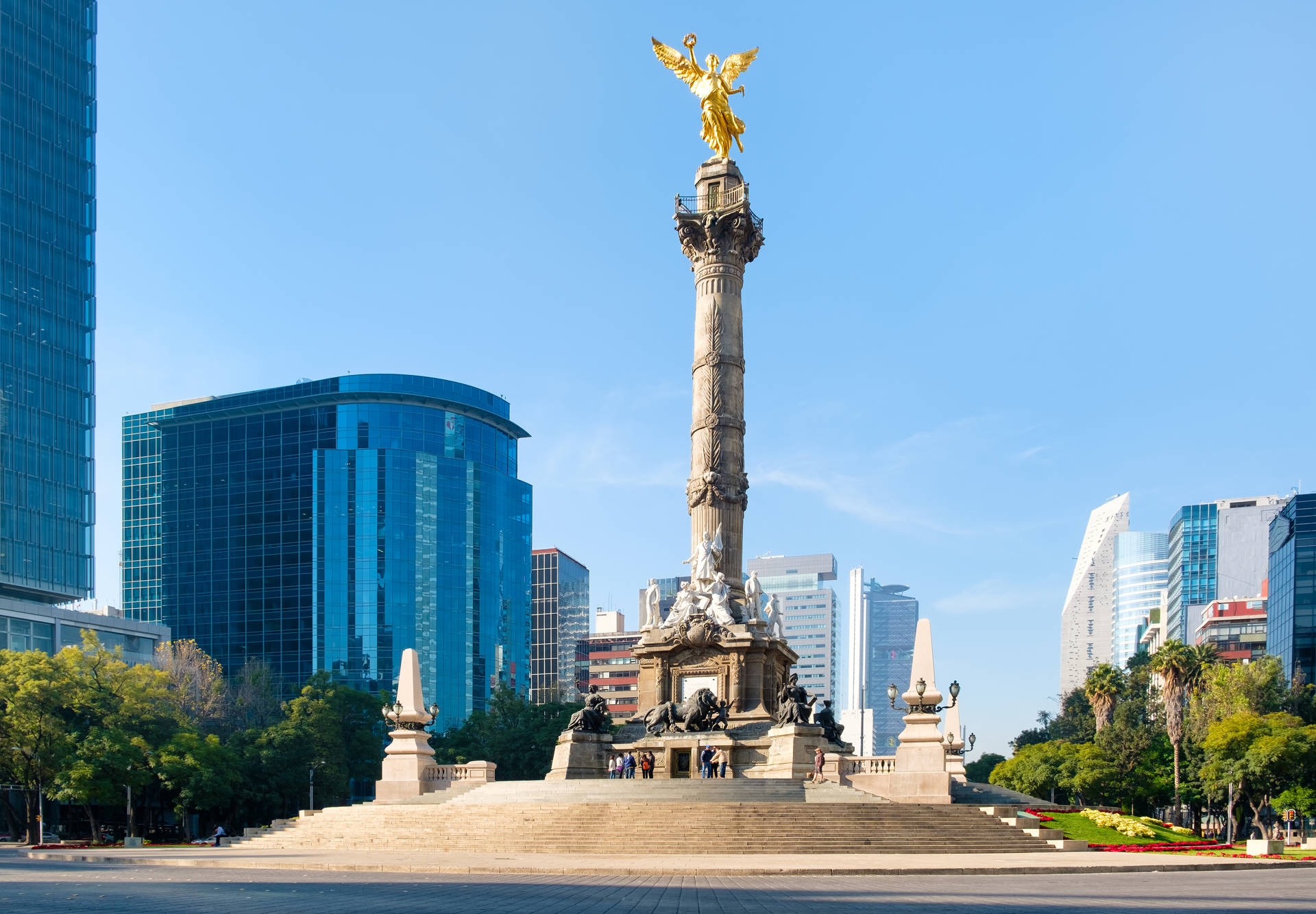
One of the most emblematic landmarks along the avenue is the roundabout that houses the monument popularly known as the Angel of Independence. This column crowned by a golden figure has become a symbol of the city and a gathering point for national celebrations. Visually, the contrast between the golden sculpture and the blue sky creates a powerful image, especially during golden hour.
From a sensory perspective, Reforma feels dynamic yet organized. The sound of traffic is constant, but the width of the avenue prevents any sense of confinement. Trees provide shade and freshness in certain sections, and on clear days, the wind moves freely along the boulevard, softening the intensity of the sun.
Further west, the corridor leads to one of the city’s most important green spaces: Chapultepec Park. This transition—from monumental avenue to expansive urban park—is one of the route’s greatest strategic advantages. Within minutes, visitors can shift from a dense urban environment to a natural setting.
Historically, Paseo de la Reforma has been the stage for demonstrations, marathons, parades, and public celebrations. It is a living space that reflects the social energy of Mexico City. It is not a static monument—it is an avenue in constant motion.
From a time-efficiency standpoint, Reforma is highly accessible. Selected sections can be explored on foot, by bicycle, or by public transportation to cover longer distances. A smart strategy is to divide the avenue into segments: begin at the Angel of Independence, walk toward Chapultepec Park, and finish at a scenic viewpoint or nearby cultural space.
For travelers who value clear logistics and budget-conscious planning, consider these practical details:
Reforma Avenue
Ciudad de México, MX
In a city as vast and vibrant as Mexico City—where every neighborhood has its own identity and history unfolds in visible layers—there is one avenue that connects the modern pulse with historical memory: Paseo de la Reforma. More than a major thoroughfare, this grand urban boulevard is a monumental corridor linking parks, iconic sculptures, financial districts, and cultural landmarks in a linear route that can be efficiently explored in half a day. For travelers arriving through Arajet’s expanding destination network and wondering what to do in Mexico City while making the most of every hour, Paseo de la Reforma offers a strategic experience that combines architecture, history, and urban life along a single axis.
Important information before your visit
- Location: Runs through central and western Mexico City
- Distance (Angel of Independence to Chapultepec): approximately 2 kilometers
- Distance from Mexico City International Airport to the Angel of Independence: approximately 14 kilometers
- Estimated travel time from the airport: 30–50 minutes, depending on traffic.
- Access: Free; it is a public avenue
- Best time to visit: Early morning or late afternoon to avoid intense heat and heavier traffic.
The ideal amount of time to explore Paseo de la Reforma depends on your pace. A focused walk between the most iconic landmarks can take two to three hours. If combined with visits to Chapultepec Park or nearby cultural institutions, the experience can easily extend into a full half-day plan.
For photography enthusiasts, Reforma offers exceptional urban perspectives. The avenue’s linear design allows for symmetrical compositions with the Angel of Independence in the foreground. Reflections in modern buildings add visual dynamism. At night, urban lighting transforms the atmosphere into something more dramatic and contemporary.
Preparation is simple. Comfortable footwear is recommended, as walking several kilometers may be part of the plan. Sun protection is important due to direct exposure along certain stretches. Carrying water is helpful, especially if combining the walk with time in Chapultepec Park.
Beyond its aesthetic appeal, Paseo de la Reforma plays a key role in understanding Mexico City’s evolution. From its origins as an aristocratic promenade to its present function as a financial and cultural corridor, the avenue reflects more than a century of urban transformation.
The experience also highlights the contrast between old and new. Within just a few meters, visitors can move from a historic monument to a contemporary glass tower. This coexistence defines the modern identity of Mexico City.
As evening falls, the avenue takes on a different atmosphere. The sky shifts to shades of pink and orange that reflect off glass façades. Traffic gradually lightens, and the boulevard becomes more pleasant for walking. It is an ideal moment to capture photographs and enjoy the changing light.
Leaving Paseo de la Reforma to explore other neighborhoods often feels like departing from the city’s urban backbone. It is more than an avenue—it is a central axis connecting history, modernity, and nature in a clear, continuous sequence.
For those flying with Arajet and planning what to do in Mexico City in a smart, urban, and well-organized way, Paseo de la Reforma is an essential experience. Monumental, versatile, and strategically located, it reveals the contemporary dimension of the capital within just a few efficiently planned hours. It proves that making the most of your time also means walking along the avenue that embodies modern Mexico—where every roundabout tells a story, and each stretch reveals a new perspective of the city.
For photography enthusiasts, Reforma offers exceptional urban perspectives. The avenue’s linear design allows for symmetrical compositions with the Angel of Independence in the foreground. Reflections in modern buildings add visual dynamism. At night, urban lighting transforms the atmosphere into something more dramatic and contemporary.
Preparation is simple. Comfortable footwear is recommended, as walking several kilometers may be part of the plan. Sun protection is important due to direct exposure along certain stretches. Carrying water is helpful, especially if combining the walk with time in Chapultepec Park.
Beyond its aesthetic appeal, Paseo de la Reforma plays a key role in understanding Mexico City’s evolution. From its origins as an aristocratic promenade to its present function as a financial and cultural corridor, the avenue reflects more than a century of urban transformation.
The experience also highlights the contrast between old and new. Within just a few meters, visitors can move from a historic monument to a contemporary glass tower. This coexistence defines the modern identity of Mexico City.
As evening falls, the avenue takes on a different atmosphere. The sky shifts to shades of pink and orange that reflect off glass façades. Traffic gradually lightens, and the boulevard becomes more pleasant for walking. It is an ideal moment to capture photographs and enjoy the changing light.
Leaving Paseo de la Reforma to explore other neighborhoods often feels like departing from the city’s urban backbone. It is more than an avenue—it is a central axis connecting history, modernity, and nature in a clear, continuous sequence.
For those flying with Arajet and planning what to do in Mexico City in a smart, urban, and well-organized way, Paseo de la Reforma is an essential experience. Monumental, versatile, and strategically located, it reveals the contemporary dimension of the capital within just a few efficiently planned hours. It proves that making the most of your time also means walking along the avenue that embodies modern Mexico—where every roundabout tells a story, and each stretch reveals a new perspective of the city.